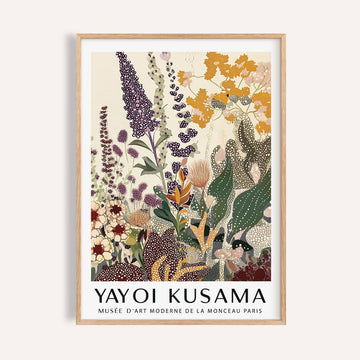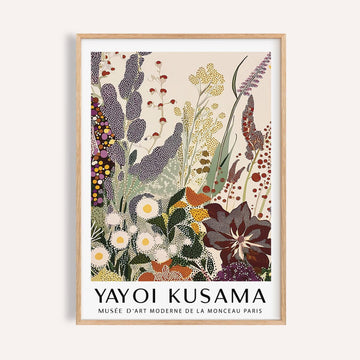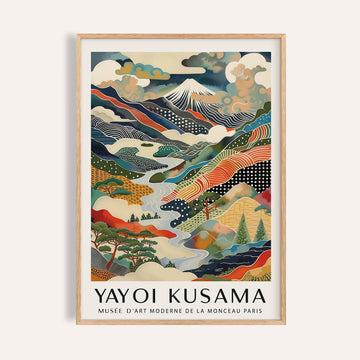
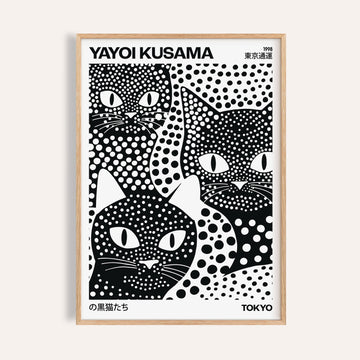
Yayoi Kusama
Yayoi Kusama is a name that resonates across continents and creative disciplines. As one of the most important living artists of our time, she has built a career that blends modern art, pop art, feminist art, and radical performance. Her unmistakable aesthetic, marked by endless polka dots, mirrored spaces, and vibrant colors, has captivated audiences in various museums around the world.
Kusama Yayoi
Born in 1929 in Matsumoto, Japan, Kusama Yayoi began creating at a young age, often using art as a way to cope with vivid hallucinations she started experiencing as a child. These hallucinations, which frequently involved fields of dots and light, would go on to define Kusama's art. She studied traditional Japanese painting styles before relocating to the United States, where her voice as a Japanese contemporary artist would grow louder and more distinct.
The Art World
Arriving in the U.S. in the late 1950s, Kusama quickly embedded herself in the New York scene. There, she found her creative footing during a transformative period in art history. She pushed against the boundaries of the American abstract impressionism and abstract expressionism movements, eventually becoming a key player in the development of international contemporary arts.
Despite the male-dominated art circles, Kusama carved out her own space. Her resilience was fueled by an uncompromising commitment to creative freedom and a need to express her inner world. Today, she is represented in collections at the Museum of Modern Art, Tate Modern, and the National Gallery Singapore, among other major museums.
Polka Dots
If there is one motif most associated with Kusama, it’s polka dots. These dots, sometimes referred to as "infinity dots," represent more than just a decorative style. They are a symbol of the universe and her place within it. Her use of brightly colored polka dots has become both playful and profound, adorning not only canvases but also sculpture gardens, nude performers, pumpkins, and even entire rooms.
Her iconic polka-dotted pumpkins are now synonymous with Kusama’s art, appearing in galleries and art exhibitions worldwide. They reflect her deep connection to nature and childhood memories, while also representing the repetitive and all-consuming visions from her hallucinations.
New York
Kusama began her journey in New York in 1958, at a time when the city was the epicenter of the art world. There, she met artists like Andy Warhol, Claes Oldenburg, and Donald Judd, and even held her own solo exhibition. Yet, her relationship with Warhol was complicated. While both were immersed in pop art and performance, Kusama accused Warhol of appropriating her ideas, particularly after he began creating repetitive wallpaper installations similar to her dot-infused environments.
Despite these tensions, her influence continued to grow. She staged provocative happenings that featured naked dancers and nude participants, often covered in polka dots, as a form of feminist art and protest against the Vietnam War. These performances not only challenged societal norms but also positioned her as a key figure in the hippie counterculture movement.
Infinity Mirror Rooms
The first of Kusama’s Infinity Mirror Rooms appeared in the 1960s, using mirrors to create a boundless sense of space and light. These installations encapsulated her vision of obliteration and self-loss, drawing from her experiences with hallucinations and mental illness.
Visitors stepping into these rooms encounter a surreal world of dancing lights, hanging spheres, and endless reflections. Notable works include "All the Eternal Love I Have for the Pumpkins" and "Dancing Lights That Flew Up to the Universe." These pieces are not merely visual spectacles. They are immersive meditations on time, space, and the self.
Infinity Rooms
While "infinity mirror rooms" refer to a specific format, the broader concept of infinity rooms underlines Kusama's lifelong obsession with repetition, reflection, and immersion. Whether it's her mirrored spaces or her paintings from the "Infinity Nets" series, the theme remains constant: transcendence through pattern.
Her works often explore the tension between individuality and collective identity, with mirrors and dots blending every boundary. The viewer becomes part of the art, surrounded by their own reflections and the boundless universe Kusama creates.
Andy Warhol
Kusama’s work and persona were both shaped in parallel with Andy Warhol, though their trajectories diverged. Warhol enjoyed early fame and financial success. Kusama, facing sexism and xenophobia, struggled for recognition. Still, her originality and endurance eventually cemented her as not just a peer to Warhol but as someone who helped redefine the role of the artist in society.
Their simultaneous involvement in pop art and provocative public events shows just how much they influenced each other, even if their relationship was fraught. Warhol's New York Stock Exchange piece, for example, echoes Kusama's themes of repetition and scale.
Artistic Career Across Continents
After years of intense production and struggle, Kusama returned to Japan in the 1970s, voluntarily entering a psychiatric hospital where she still resides. From this space, she continued creating art, working daily in her studio and producing some of her most iconic and introspective works. Her artistic output did not slow; it only evolved.
Her exhibitions have reached major retrospectives in places like the Hirshhorn Museum, Victoria Miro Gallery, Tate Modern, and the Pérez Art Museum Miami. Museums such as the Helsinki Art Museum, Louisiana Museum, and Los Angeles County Museum have also hosted shows celebrating her work.
Cosmic Nature and Global Influence
In 2021, the New York Botanical Garden hosted "Cosmic Nature," a groundbreaking show integrating Kusama's work with the natural environment. This exhibit highlighted her fascination with organic forms, bridging her lifelong motifs of growth, repetition, and the infinite.
Kusama has represented Japan in international exhibitions, becoming a beloved figure across borders. Her influence spans generations of artists and thinkers. From traditional Japanese painting styles to American abstract impressionism, Kusama has crossed and blurred every line of categorization.
The Only Method
For Kusama, art is more than a career. It has always been her "only method" for survival. Through struggles with mental illness, the trauma of World War II, and the pressures of the art world, she used creativity as both shield and sword. "If it were not for art, I would have killed myself long ago," she once said.
This raw honesty resonates deeply with audiences. Her art is emotional, obsessive, often repetitive. But always sincere. It’s a reflection of her need for personal and creative freedom, which she fought for relentlessly, even when the art movement didn't understand her.
Legacy in Art History
Today, Kusama is not just a successful living artist; she is a phenomenon. From the Smithsonian Institution to Ota Fine Arts and the National Museum of her native Japan, her work continues to attract millions of visitors. Her story is one of resilience, radical vision, and infinite imagination.
As her artistic career continues into her nineties, Kusama stands as a symbol of what it means to live for art, to let it consume, define, and ultimately save you.