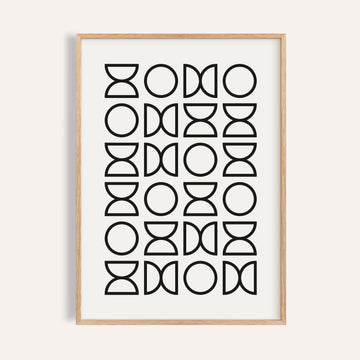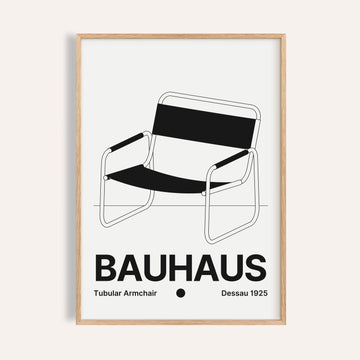
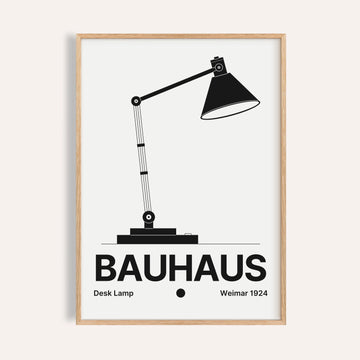
For the same bold geometry in a shoppable format, explore our Bauhaus art prints and art prints and posters.
Bauhaus graphic design remains one of the most influential movements in design history. Its bold simplicity, geometric forms, and commitment to functionality still inspire designers, architects, and art lovers today. At Laboo Studio, we celebrate the clean lines and visionary creativity of the Bauhaus aesthetic in many of our curated art prints. This guide explores the history, philosophy, and enduring impact of the Bauhaus movement in the world of graphic design.
What Is Bauhaus Graphic Design?
Bauhaus graphic design refers to a style developed during the early 20th century at the Bauhaus school in Germany. It blends fine arts, industrial design, and modern principles into a unified, functional approach. Designers embraced sans serif typefaces, strong grids, and geometric shapes to create clarity and simplicity.
Origins of the Bauhaus School
The Bauhaus school, formally Staatliches Bauhaus, was founded by German architect Walter Gropius in 1919 in Weimar. His goal was to unify art, craft, and technology to serve the needs of the modern age. The idea was revolutionary: break down the hierarchy between artist and craftsman and focus on design education for a changing world.
The Bauhaus Movement and Its Mission
The Bauhaus movement aimed to create a new visual language for the 20th century. It rejected ornamentation and historical revivalism in favor of minimalism, abstraction, and purpose-driven design. This approach touched everything, from architecture and furniture to posters and typography.
Key Figures of the Bauhaus
Some of the most celebrated Bauhaus artists and designers include:
-
Walter Gropius – German architect and founder of the school
-
Herbert Bayer – Pioneer of Bauhaus poster design and modern typography
-
Paul Klee – Painter and influential Bauhaus teacher
-
Wassily Kandinsky – Known for abstract works and color theory
-
Josef Albers – Innovator in color studies and modern design education
-
Marcel Breuer – Iconic furniture designer
-
Joost Schmidt – Graphic designer and creator of the famous 1923 Bauhaus poster
These figures helped shape not only Bauhaus graphic design but also the future of design education and artistic expression.
Bauhaus Style: Visual Traits and Principles
The Bauhaus style is immediately recognizable. It features:
-
Geometric shapes like circles, triangles, and squares
-
Sans serif fonts for clean readability
-
Primary colors with bold contrasts
-
Flat compositions with structured layouts
-
Asymmetry used intentionally for visual balance
These elements reflect the movement’s emphasis on function, legibility, and visual efficiency.
The Influence of Geometric Shapes
Geometric forms became a Bauhaus trademark. Designers used basic shapes to build layouts, typefaces, and illustrations. This reduction to essential forms helped unify art with industrial production, aligning with the Bauhaus goal to serve modern needs.
The Impact of Herbert Bayer
Herbert Bayer revolutionized Bauhaus graphic design. He eliminated capital letters from his typography to create more consistent, readable text. His poster design style emphasized clean lines, photomontage, and simple forms. Bayer’s work helped define modern graphic design.
Bauhaus Poster Design
Bauhaus poster design wasn’t about decoration. It was about communication. Posters featured sans serif type, structured layouts, and striking use of color. They were meant to grab attention, inform quickly, and reflect the new Bauhaus aesthetic.
Modern Typography and New Typefaces
The Bauhaus era gave rise to new typefaces that broke away from traditional serif fonts. Designers like Bayer introduced clean, minimal letterforms that would influence decades of modern typography. Today, Bauhaus-inspired fonts remain staples in contemporary design.
The Role of the Preliminary Course
Early Bauhaus students took a foundational course called the preliminary course. Here, they learned the basics of color theory, material properties, composition, and formal qualities. This foundation helped unify art and craft and shaped a generation of multidisciplinary creators.
Bauhaus Curriculum: Redefining Design Education
The Bauhaus curriculum integrated theory and hands-on practice. Students studied basic design, architecture, painting, and industrial design. Workshops replaced lecture halls. The goal was to build well-rounded designers capable of tackling real-world problems.
Bauhaus and Furniture Design
Beyond graphic work, the Bauhaus left its mark on furniture. Marcel Breuer’s tubular steel chairs became icons of modern furniture design. These pieces exemplified the Bauhaus emphasis on minimalism, function, and mass production.
The Bauhaus Building: A Symbol of Modernism
The Dessau building, designed by Walter Gropius, became a physical embodiment of Bauhaus ideals. Its bold, functional architecture and modular structure showcased the union of form and function. Today, it’s recognized worldwide as a landmark of modernist design.
Interior Design and the Bauhaus Aesthetic
In interior design, the Bauhaus style translated to sleek, efficient spaces. Clean lines, modular storage, and simple materials reflected a functional approach. The goal wasn’t opulence. It was clarity and purpose.
Bauhaus Emphasis on Mass Production
The Bauhaus aimed to make quality design accessible to the masses. That meant designing products, furniture, posters, buildings. That could be mass produced. This mindset helped bridge the gap between fine arts and industrial design.
The Influence of the German Expressionist Movement
While Bauhaus design was modern and rational, it emerged alongside the emotional and abstract forms of German expressionism. This blend of logic and emotion added depth to the Bauhaus aesthetic.
Bauhaus Designers in the Modern Age
Today’s graphic designers still look to Bauhaus for inspiration. From editorial design and magazine covers to digital interfaces, Bauhaus design principles remain deeply embedded in contemporary design.
The Role of Art Education and the New Bauhaus
After the original Bauhaus closed under pressure from the Nazi regime, several faculty members moved abroad. In 1937, the New Bauhaus was founded in Chicago by László Moholy-Nagy, continuing the movement’s legacy in American design education.
Mies van der Rohe and Architecture
Another former Bauhaus figure, Mies van der Rohe, helped carry the movement into the architectural mainstream. His minimal buildings and famous phrase “less is more” remain central to the Bauhaus approach.
The End of the Bauhaus in Germany
Political tension during the Weimar Republic and the rise of the Nazi regime led to the closure of the Bauhaus school in 1933. But its impact had already taken root, spreading globally through its teachers and students.
Editorial Design and Bauhaus Influence
Bauhaus design principles shaped editorial design in magazines and books. Grids, sans serif typefaces, and hierarchical layout became standard tools in creating clean, readable publications.
Bauhaus Poster Design in Contemporary Culture
Today, Bauhaus poster design lives on through reproductions, museum collections, and design studios. At Laboo Studio, we carry Bauhaus-inspired art prints that showcase geometric elegance and historical impact.
The Metropolitan Museum and Bauhaus Collections
Institutions like the Metropolitan Museum preserve and showcase original Bauhaus posters, typography, and furniture. These collections highlight the lasting artistic expression of the school’s students and contemporaries.
Bauhaus Style Font and Visual Identity
The Bauhaus style font, minimal, functional, geometric, was more than type. It was a statement. It represented a modern worldview: rational, efficient, and universally accessible.
Primary Colors and Color Theory
Primary colors were a cornerstone of Bauhaus color theory. Red, yellow, and blue were used for clarity and emotional effect. Artists like Kandinsky and Albers developed their own theories on how color impacts mood and perception.
Bauhaus Moved: From Weimar to Dessau to Berlin
The Bauhaus didn’t stay in one place. It began in Weimar, moved to Dessau, and finally relocated to Berlin before closing. Each location influenced the school’s evolution and its architectural expressions.
The Functional Approach to Art
At its core, Bauhaus promoted a functional approach to all forms of art and design. Beauty was found in usefulness. Form followed function. And design was about solving problems, not just creating visuals.
Legacy of the Bauhaus in Contemporary Design
The Bauhaus graphic design legacy continues to inform everything from branding and websites to home decor and education. Its core principles, simplicity, clarity, unity, are more relevant than ever.
Laboo Studio and the Bauhaus Legacy
At Laboo Studio, we honor the Bauhaus design movement with curated prints that capture the clarity, contrast, and visual harmony of this style. Whether you're a fan of geometric shapes, bold typography, or modern minimalism, you’ll find pieces that echo the Bauhaus spirit.