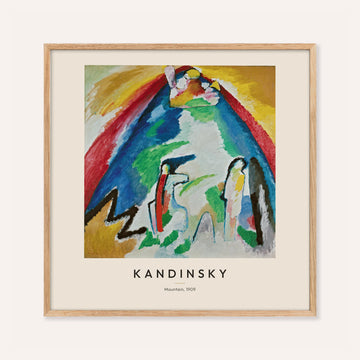
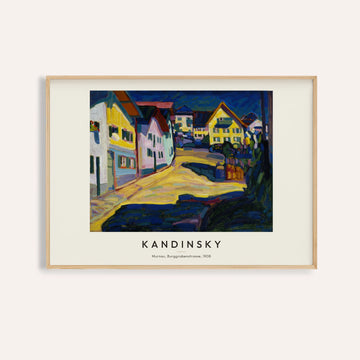
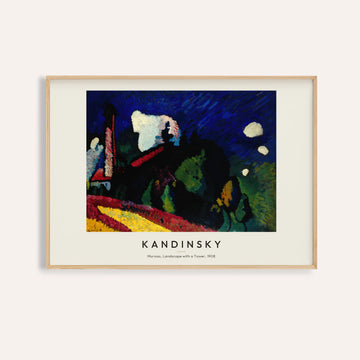
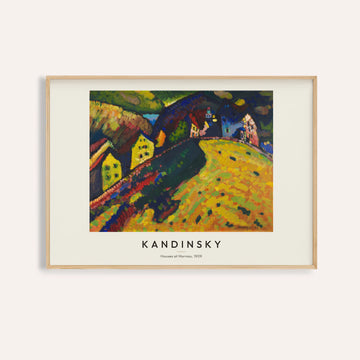
Kandinsky paintings changed what a picture could be. In about twenty years Wassily Kandinsky went from bright village streets in Bavaria to circles, grids and lines that show nothing but colour and movement, and along the way he painted some of the first fully abstract pictures in Western art. This guide follows that journey in order, from the Murnau summers to the Bauhaus, with the prints in our range that show each step.
Who was Wassily Kandinsky?
Kandinsky was born in Moscow in 1866. He studied law and economics and was set for a university career when, at the age of thirty, he gave it up and moved to Munich to train as a painter. He later wrote that two experiences pushed him there: seeing one of Monet's haystack paintings, which he could not at first make out as a haystack at all, and hearing Wagner's Lohengrin, where the music seemed to paint colours in his mind.
That link between colour and sound runs through all of his work. He gave his pictures musical names such as Improvisation and Composition, and in 1911 he published Concerning the Spiritual in Art, a short book arguing that colour could move the soul the way music does, without needing to show anything recognisable.
Murnau: the colour years
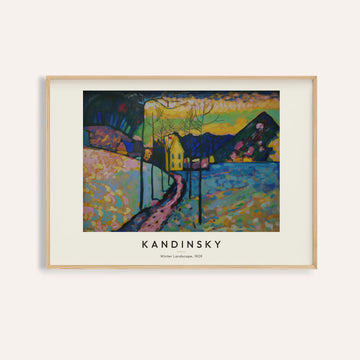
From 1908 Kandinsky spent his summers in Murnau, a market town south of Munich at the edge of the Alps, with the painter Gabriele Münter. Here his landscapes caught fire. Shadows turned violet, roads turned gold, and houses became flat blocks of white and yellow.
Our Murnau, Burggrabenstrasse print shows a village street on a summer day, and the Houses at Murnau print follows a row of yellow houses up a golden hill. The Church at Murnau square print puts the onion topped church tower on a hilltop, a shape he painted so often that it slowly became a sign rather than a building. For deep colour, the Murnau, The Garden II exhibition poster shows the garden of Münter's house in full bloom against a dark blue ground.
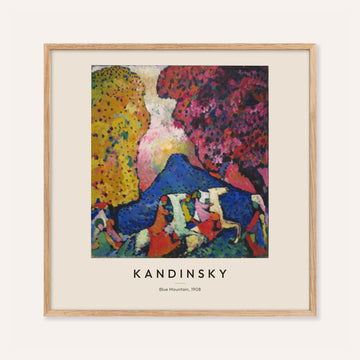
Riders appear again and again in these years. In Blue Mountain three horsemen gallop past the foot of a deep blue peak between trees dotted with red and gold.
The Blue Rider and the first abstract pictures
In 1911 Kandinsky and Franz Marc founded Der Blaue Reiter, The Blue Rider, a circle of artists who held exhibitions in Munich and published an almanac on art and music. Kandinsky said the name came from their shared love of blue and of horses and riders. Our The Rider (Improvisation 12) print shows that favourite figure at full gallop inside sweeping arcs of red, blue and white.
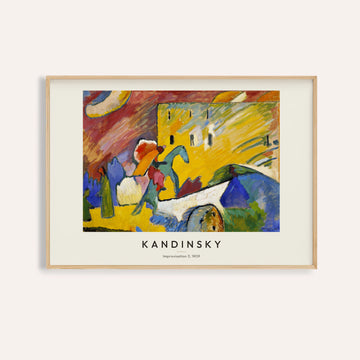
The same year he heard music by Arnold Schoenberg at a concert in Munich and painted Impression III (Concert) within days. A great black shape, the grand piano, floats over a field of yellow sound while the audience leans in from the lower left. It is one of the clearest examples of Kandinsky painting what he heard rather than what he saw.
Impressions, Improvisations and Compositions
Kandinsky sorted his pictures into three kinds. Impressions began with something he had actually seen, a park or a concert hall. Improvisations were quick, unplanned expressions of inner feeling. Compositions were the big, slowly built works, prepared with many studies, and he kept that word for only ten pictures in his whole life.
You can see the difference across our range. Impression V (Park) reduces a park to a red rider and a few black lines on a pale ground. Improvisation 26 (Rowing) turns a boat into curves and the long black strokes of oars. Improvisation 30 (Cannons), painted in 1913, has two cannons firing at the lower right; Kandinsky later said they probably crept in from all the talk of war that year.
What is Kandinsky's most famous painting?
There is no single answer, but three pictures come up most. Composition VII, from 1913, is often called his greatest work before the First World War: a whirl of colour and line built from more than thirty studies and then painted in just a few days. Composition VIII, from 1923, is the calm, geometric answer to it, and Kandinsky himself called it the high point of his work after the war.
The third is the one most people picture when they hear his name. Squares with Concentric Circles began in 1913 as a small colour study in Munich: twelve squares, each holding its own set of rings, testing how a colour changes beside its neighbours. It has since become one of the best known images in modern art, and it suits almost any room.
Kandinsky's circles: the Bauhaus years
During the war Kandinsky returned to Russia. He came back to Germany at the end of 1921, and in 1922 he began teaching at the Bauhaus, the famous school of art and design, first in Weimar and from 1925 in Dessau. His painting changed again. Circles, triangles, grids and fine straight lines took over, set out with great care on calm grounds.
At the Bauhaus he asked students to match yellow, red and blue with a triangle, a square and a circle, and our Yellow Red Blue print plays with exactly those pairings. In 1926 he published Point and Line to Plane, his book on the basic elements of painting, and painted Several Circles, where coloured discs float and overlap on a deep, smoky ground. He felt the circle was the most balanced shape and also the most full of inner tension, and in these years he used it more than any other.
The later pictures in our range include Accent on Pink, a tilted cream square with a pink circle at its heart, Deepened Impulse, with its circles gathered like bubbles, and Thirteen Rectangles from 1930, a stack of red, blue and yellow blocks on warm beige. The Bauhaus closed under Nazi pressure in 1933, and Kandinsky moved to France, where he died in 1944.
How to choose Kandinsky paintings for your home
The early Murnau landscapes are warm and full of colour, so they sit well in kitchens, hallways and living rooms with mustard, sage or terracotta walls. The Improvisations and Impressions have more movement and suit a home office or a living room with plain white or pale grey walls, where the colour can do the work. The Bauhaus paintings are the most graphic and pair naturally with mid century furniture, clean lines and simple shelving.
Two or three prints from the same period make an easy set. The circles of Several Circles, Squares with Concentric Circles and Yellow Red Blue look good together, and the Murnau street, houses and church form a little village of their own. Wide paintings come as landscape posters, nearly square ones sit on a square of cream paper, and upright ones come as exhibition posters.
Bringing Kandinsky paintings home
Every print in our range is a reproduction of a real Kandinsky painting dated 1930 or earlier, made from a high resolution scan that is now in the public domain. They are not originals and not official museum or exhibition posters. We add the layout, the cream border and the lettering, with KANDINSKY in wide spaced capitals, a thin gold rule and the title and year beneath, and each print is made to order on premium matte paper and sold unframed to fit standard frames.
The Bauhaus pictures sit happily beside our Bauhaus posters, and the abstract works mix well with the rest of our abstract wall art prints. To see every painting in one place, browse our Kandinsky prints collection.
Ready to choose? Explore the full range of Kandinsky prints and find the period that suits your room.