Monet garden paintings span almost fifty years of Claude Monet's life, from the rented house at Argenteuil in the 1870s, through the sunflowers at Vétheuil, to the flower beds and water lily pond he made at Giverny. Monet was a keen gardener as well as a painter, and wherever he lived he planted something worth painting. This guide walks through each garden, the pictures that came out of it, and the prints in our range that show them.
What was Monet's garden called?
When people talk about Monet's garden they usually mean Giverny, the village in Normandy where he lived from 1883 until his death in 1926. The garden there has two halves. In front of the house is the flower garden, known as the Clos Normand, laid out in long straight beds. Across the road lies the water garden, with the pond, the water lilies and the Japanese footbridge. But Giverny was his last garden, not his first, and some of his loveliest garden pictures were painted long before he arrived there.
Argenteuil: the first garden paintings
From the early 1870s Monet rented a house in Argenteuil, a small town on the Seine just outside Paris. It was here, alongside friends such as Renoir and Manet, that he worked out the loose, bright way of painting outdoors that we now call Impressionism, and his own garden became one of his favourite subjects.
The Artist's Garden in Argenteuil, from 1873, is also known as A Corner of the Garden with Dahlias. A bank of red and pink dahlias fills the front of the picture, the white house with its grey roof rises behind them, and a small figure stands half hidden at the side of the path. It is a summer afternoon caught in quick strokes of colour. You can have it as a museum style Argenteuil garden poster or as a wide landscape print that shows the whole scene.
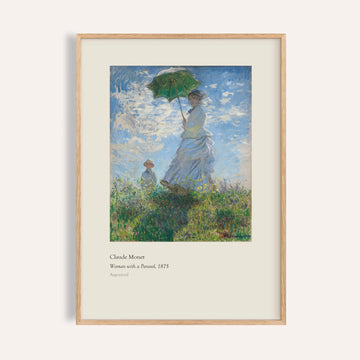
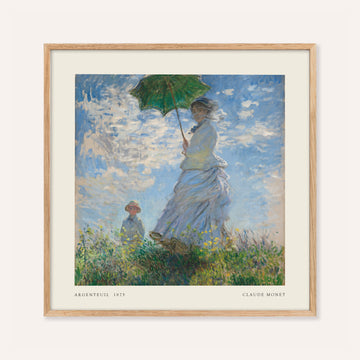
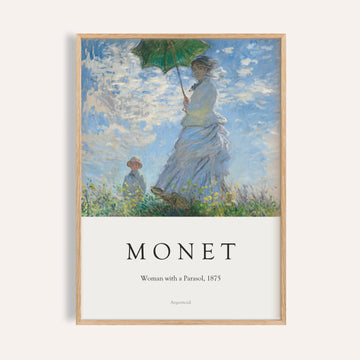
From the same years comes Woman with a Parasol, painted in 1875, with Monet's wife Camille and their son Jean on a breezy hillside near Argenteuil. It is a meadow rather than a garden, but the white dress, blue sky and windswept grass carry the same feeling. Our Woman with a Parasol poster shows one of the best known paintings in the range.
Vétheuil: sunflowers on the steps
In 1878 the family moved further down the Seine to Vétheuil. These were hard years. Money was short and Camille died there in 1879. Yet the garden at Vétheuil produced one of Monet's brightest pictures.
The Artist's Garden at Vétheuil, painted in 1881, looks up a sunlit path towards the house. Huge sunflowers crowd both sides, taller than the small figures on the steps, and the blue sky and white clouds sit above the roof. It is an upright painting, so it works especially well in our gallery mount print, which places the whole picture on a warm mount with a small label beneath. There is also a museum poster.
Monet brought the garden indoors too. Jerusalem Artichoke Flowers, from 1880, is a dense bunch of yellow blooms, a close relative of the sunflower, painted with quick, curling strokes. The Jerusalem Artichoke Flowers print brings a burst of yellow to a kitchen or dining room. Nearby, Banks of the Seine, Vétheuil shows wild flowers and long grass in the foreground with the river and a row of poplars beyond, and our landscape print keeps that wide view.
Giverny: the garden Monet built to paint
Monet first rented the house at Giverny in 1883 and bought it in 1890. Over the following years he turned the orchard in front of it into the Clos Normand, planting it so that something would be in flower from spring to autumn. In 1893 he bought a plot of land across the road and began making a pond fed by a nearby stream, which became the water garden.
The water garden was designed to be painted. Monet planted water lilies on the pond, willows and bamboo around its banks, and built a curved wooden footbridge in the Japanese style, inspired by the Japanese prints he collected and hung throughout the house. For the rest of his life the pond was his main subject, and his eyesight grew weaker in his later years as cataracts clouded his vision. The great water lily murals he painted at the end of his life now fill two oval rooms at the Musée de l'Orangerie in Paris.
The river at Giverny mattered to him as well. In The Seine at Giverny, from 1897, trees and their reflections melt together in early morning haze, with almost no line between bank and water. The Seine at Giverny landscape print is one of the quietest pictures in the range.
The Japanese Footbridge
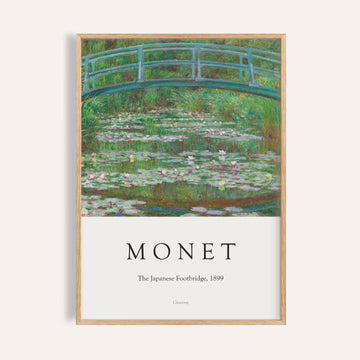
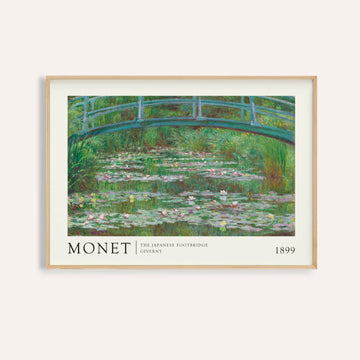
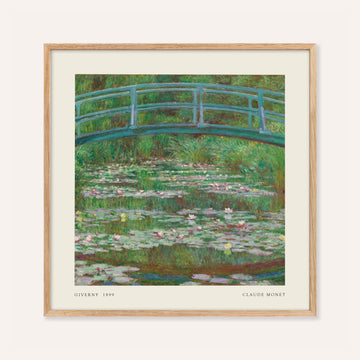
The Japanese Footbridge is one of a group of views of the bridge that Monet painted in 1899, and it is one of the best loved of all Monet garden paintings. A pale green bridge arches across the top of the picture, the pond below is covered in water lily pads with pink and white flowers, and dense green foliage closes in on every side so there is no sky at all.
It comes in every layout. The Japanese Footbridge museum poster sets it above a cream band with MONET in large letters, the landscape version shows the full width of the bridge, and the square print suits a small wall or a grid.
What flower is Monet known for?
The water lily, without question. Monet painted his lily pond hundreds of times, and the French name for the series, Nymphéas, is closely tied to his name. But his gardens were full of other flowers he loved to paint: dahlias at Argenteuil, sunflowers at Vétheuil, and at Giverny irises, poppies, roses and the wisteria that later grew over the footbridge.
Is Giverny worth visiting?
If you love these pictures, yes. The house and both gardens are open to visitors for part of the year, usually from spring until the start of November, so check the dates before you travel. From Paris it is a short train ride to Vernon, then a shuttle bus or taxi to the village, and early morning is the calmest time to see the water garden before the crowds arrive.
Bringing Monet garden paintings home
Every print in our range is a reproduction of a real Monet painting, made from high resolution museum scans that are now in the public domain. They are not originals and not official museum posters. We add the layout, the cream borders and the lettering in a classic serif typeface, and each print is made to order on premium matte paper with fade resistant pigment inks, sold unframed to fit standard frames.
The garden pictures sit naturally beside our other flower art prints and botanical prints, and two or three of them together make an easy, colourful gallery wall. To see every painting and layout in one place, browse our Claude Monet prints collection.
Ready to bring a little of Monet's garden home? Explore the full range of Monet prints and choose the garden that suits your room.