The Monet London paintings are the views of the River Thames that Claude Monet painted on three winter visits to the city between 1899 and 1901. He worked from a room at the Savoy Hotel and from a terrace at St Thomas' Hospital, chasing the light through fog and smoke, then finished the pictures in his studio at Giverny and showed them in Paris in 1904. They fall into three groups: Charing Cross Bridge, Waterloo Bridge and the Houses of Parliament. Below is the story of the series, where the originals are now, and how two of the best known can hang on your own wall.
When did Monet paint London?
Monet knew London long before the famous series. In 1870 he crossed the Channel to escape the Franco-Prussian War and spent the winter in the city. From that first stay comes The Thames below Westminster, a quiet view of the river with the new Houses of Parliament in mist, which now hangs in the National Gallery in London.
Almost thirty years later he came back, this time as a successful painter with money to spend on a good hotel. He visited in the autumn of 1899, again in early 1900 and again in early 1901, each time in the colder months. That timing was deliberate. Winter in London meant low sun, short days and the thick fog that Monet had come to paint.
Where did Monet paint his London paintings from?
Most of the series was painted from two places. His room at the Savoy Hotel, on the Embankment, looked straight out over the Thames. Turning one way he could see Waterloo Bridge; turning the other, Charing Cross railway bridge, with trains crossing it in puffs of steam. For the Houses of Parliament he needed a view from across the water, so he set up on a terrace at St Thomas' Hospital on the south bank, facing Westminster.
He did not paint one picture at a time. Monet kept a stack of pictures on the go and switched between them as the light changed, sometimes within minutes. A sunset view would come out again the next day at the same hour, if the weather allowed. In London it often did not, which is part of why the work took three trips.
Why did Monet paint London in fog?
For Monet the subject was never really the bridge or the building. It was the air in front of it. London around 1900 burned huge amounts of coal, and the smoke mixed with river mist to make fogs that turned the light yellow, pink, violet or grey depending on the hour. The buildings dissolve into flat shapes and the sun becomes a smudge of colour on the water. That is exactly what you see across the Monet London paintings: the same view repeated in different weather, so that each picture records a moment rather than a place.
The Houses of Parliament, Sunset
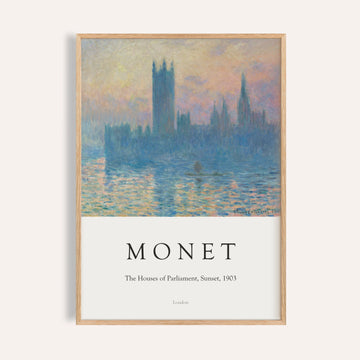
The Houses of Parliament, Sunset is one of the Parliament views painted from the hospital terrace. The towers of Westminster stand as a single blue silhouette against a sky of peach, rose and lilac. A pale sun hangs high on the left, its light breaking into orange flecks on the river, and a small dark boat sits low on the water in the foreground. Almost nothing is drawn with a hard edge, yet you know the building at once.
We print it in three layouts. The museum style Houses of Parliament poster sets the painting above a cream band with MONET and the title in classic serif type. The wide landscape version keeps the whole river view and runs the name, title and year along the bottom. For a smaller wall, the square print focuses on the colour of the sky.
Waterloo Bridge at Sunset
Waterloo Bridge was the view from Monet's own window, and he painted it more often than either of his other London subjects. In Waterloo Bridge at Sunset the arches are barely there: a row of soft curves in blue haze, with the low sun turning the mist around them pale pink and gold. It is a gentler, cooler picture than the Parliament sunset, and it suits a calm room such as a bedroom or a hallway.
You can choose the Waterloo Bridge museum poster or the landscape print that shows the full span of the bridge.
Why are the London paintings dated 1903 and 1904?
If you look up the paintings you will often see dates of 1903 or 1904, even though Monet's last London trip was in 1901. The reason is that he carried the unfinished pictures home and kept working on them at Giverny for years, painting from memory and from the other pictures in the set so that the series would hang together. Museums usually date each picture to when it was signed and finished. In May 1904 the art dealer Paul Durand-Ruel showed more than thirty of the Thames views at his gallery in Paris, and the exhibition was a success.
Where are the Monet London paintings now?
The series was sold off picture by picture, so today it is spread across collections in Europe and America, from the Musée d'Orsay in Paris to museums across Britain and the United States. Only rarely are the London views seen together. From September 2024 to January 2025 the Courtauld Gallery in London gathered a group of them for an exhibition about the series, a rare chance to see them in the city they show.
People often ask whether you can buy a real Monet. Originals do still come up at auction, but the London views that have sold in recent years have sold for millions. For almost everyone, a good print of the painting is the realistic way to live with it.
Are these Monet London prints originals?
No, and we want to be clear about that. Our prints are reproductions of the real paintings, made from high resolution museum scans that are in the public domain because Monet died in 1926. They are not original works, and they are not official museum posters or museum merchandise. What we add is the layout: the cream paper borders, the MONET lettering and the title and year set in a classic typeface, so each one reads like an exhibition print.
Each print is made to order on premium matte paper with fade resistant pigment inks and sold unframed, sized to fit standard frames. You can see every painting and layout together in our Claude Monet prints collection.
Styling Monet's London at home
The London pictures are mostly blue, lilac and soft peach, so they sit well with grey, white and warm neutral walls. Hang the Parliament and Waterloo Bridge landscape prints side by side above a sofa and they read as a pair, which is how Monet meant the series to be seen. If you are building a city wall, they mix happily with more graphic pieces from our London wall art, and the museum layouts work well in a gallery wall alongside other classic art posters.
Ready to bring the Thames home? Browse the full range of Monet prints and pick the view that suits your room.